
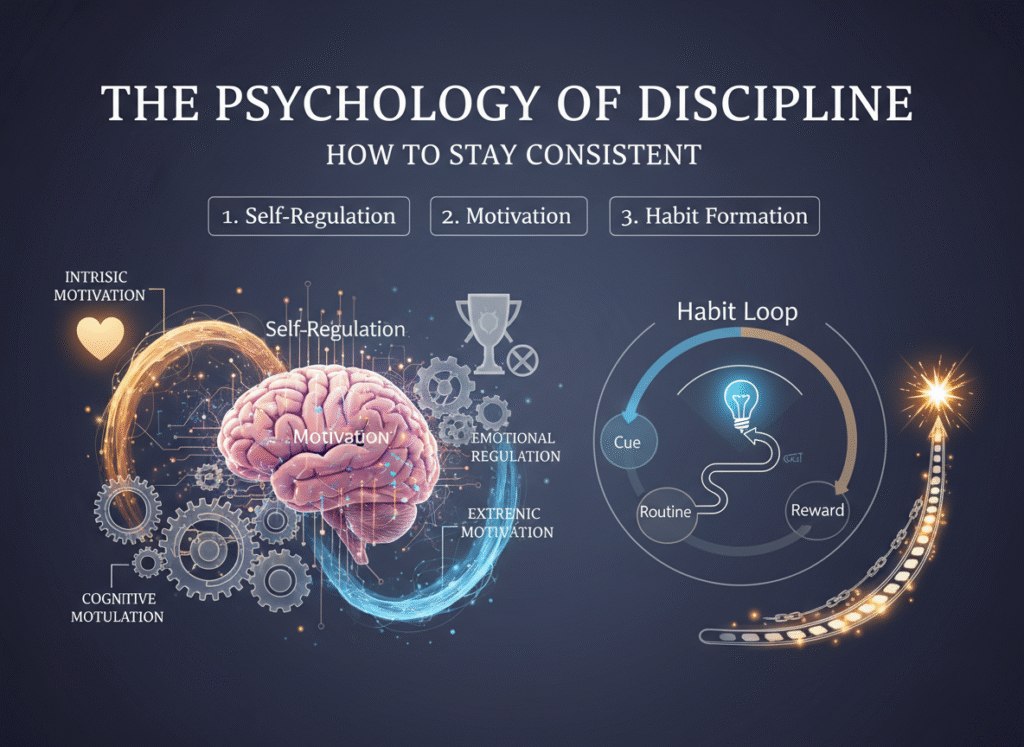
Everyone wants discipline…
but very few people understand the psychology behind it.
Most people think discipline is about motivation, willpower, or being “stronger” than everyone else.
But the truth is much simpler:
Discipline is a psychology.
Not a personality trait.
It’s not about being perfect — it’s about understanding how your mind works, and working with it instead of against it.
Here’s how discipline really works, and how you can finally stay consistent.
🔥 1. Discipline starts with identity, not action
If you see yourself as someone who:
- “can’t stick to routines”
- “always quits”
- “is easily distracted”
…your brain will subconsciously act in ways that match that identity.
Behavior follows identity.
Instead of saying:
“I want to be disciplined,”
say:
“I’m becoming the kind of person who finishes things.”
Shift the identity → reshape the habits.
🔥 2. Your brain hates big goals — but loves small wins
Your mind is designed to avoid overwhelm.
That’s why big goals feel scary, stressful, and unrealistic.
But when a habit takes only 2–5 minutes, your brain says:
“Easy. Let’s do it.”
That’s why micro-habits work.
Examples:
✔ 2 minutes of exercise
✔ 5 minutes of reading
✔ 10 minutes of work
✔ One small task each morning
Small wins create momentum — and momentum creates discipline.
🔥 3. Motivation is a lie — systems are the truth
Motivation disappears.
Discipline stays.
People who rely on motivation are inconsistent.
People who rely on systems become unstoppable.
A system is a simple rule that never changes:
- “I work out every day at 7 PM.”
- “I read 10 minutes after breakfast.”
- “I write for 15 minutes before bed.”
Systems make habits automatic.
You stop thinking — you just do.
🔥 4. Your environment matters more than your willpower
You don’t rise to the level of your goals.
You fall to the level of your environment.
If your environment is full of:
❌ distractions
❌ clutter
❌ noise
❌ temptations
❌ chaos
…your discipline will collapse.
But if you design your environment to support your habits:
✔ clean workspace
✔ visible reminders
✔ phone away
✔ routines set
✔ no friction
…discipline becomes easy instead of painful.
🔥 5. Dopamine controls your consistency
Every habit you keep gives you a dopamine reward.
The problem?
Your brain gets dopamine faster from:
- scrolling
- YouTube
- junk food
- gossip
- comfort
So it chooses the wrong habits.
You must retrain your brain to crave the right ones — through tiny, achievable wins that feel good.
Dopamine is not your enemy.
It’s your engine.
Use it correctly.
🔥 6. Consistency comes from emotional regulation, not toughness
Most people think they lack discipline.
But actually, they lack emotional stability.
You quit because you feel:
- stressed
- tired
- insecure
- overwhelmed
- discouraged
Not because you are weak — but because your emotions take over.
When you learn to stay calm and centered, consistency becomes natural.
Discipline is emotional intelligence in action.
🔥 7. You don’t need to be perfect — you need to restart fast
The biggest difference between disciplined and undisciplined people is simple:
Disciplined people don’t stay down.
They miss a day… and get back on track.
They make a mistake… and correct it fast.
They fall off… but never quit.
Restarting is a skill.
Practice it.
⭐ A Simple Discipline Formula (That Actually Works)
✔ Start small
✔ Do it daily
✔ Attach it to a routine you already do
✔ Make it easy, not painful
✔ Remove distractions
✔ Don’t wait for motivation
✔ When you fail, restart within 24 hours
This formula works for fitness, business, relationships, studying, money — everything.
⭐ The Truth
Discipline is not punishment.
It’s self-respect.
It’s choosing your future self over short-term comfort.
It’s building a life you’re proud of — one tiny action at a time.
Consistency isn’t about being strong.
It’s about being self-aware and intentional.
Master the psychology of discipline…
and nothing will be out of reach.